Trademark Infringement Damages in Europe
Someone is using your trademark without permission — copying your brand, selling counterfeit goods under your name, or riding on the reputation you spent years building. You take them to court. You win. But what happens next? How much can you actually recover — and how do you get it? The answers depend far less on the strength of your case than on something most brand owners never think about: which country’s courts are deciding it. According to data from the IP litigation database Darts-IP — with all the caveats that come with any litigation database — the differences between European jurisdictions are remarkable: France alone generates more trademark damage awards than any other country on the continent, while Turkey, which sees more trademark court cases than anywhere else in Europe, produces very few. These are not random outcomes. They are the predictable result of seven fundamentally different national legal systems, each with its own rules, procedures, evidence tools, and judicial culture — all operating under the illusion of a unified European framework.
This article cuts through that complexity. Detailed statistics will show you what countries are important with regard to trademark infringement cases. Whether you are a brand owner trying to understand what you could actually recover if your trademark is infringed, a company that has received a cease-and-desist letter and wants to know what is at stake, or a business with cross-border exposure in multiple European markets, what you are about to read will change the way you think about trademark protection. You will learn exactly how damages are calculated in Germany, France, the UK, Italy, Spain, the Netherlands, and Turkey — what the law says, what courts actually do, and why the gap between the two is often larger than you would expect. You will understand why the EU’s attempt to harmonise damages across member states has, after twenty years, still not produced anything close to a level playing field. And you will see, in concrete terms, why the jurisdiction where you file a case — and the strategy behind how you file it — can be the difference between meaningful financial compensation and a moral victory that costs more than it recovers.
Table of Contents
- What are the Most Relevant Countries in Europe?
- Europe’s Trademark Litigation Landscape — The Big Picture
- Turkey — Europe’s Trademark Litigation Powerhouse
- France — The Consistent European Leader
- Germany — High Volume, Different Structure
- Italy — Strong Enforcement, Structural Undercounting
- Spain — An Underrated Enforcement Jurisdiction
- The Netherlands — Small Volume, Strategic Significance
- The United Kingdom — Sophisticated but Structurally Invisible
- What the Numbers Really Tell Us
- Notable Cases of Trademark Infringement in Europe
- What is Trademark Infringement?
- The Foundation — What a Trademark Is and What It Does
- The Core Concept — Likelihood of Confusion
- When No Confusion Is Required — Protection of Well-Known and Reputed Marks
- The Requirement of Trademark-Like Use — In the Course of Trade
- Counterfeiting — The Most Serious Form of Infringement
- False Advertising and Comparative Advertising
- Cybersquatting and Domain Name Infringement
- The Legal Framework — How Trademark Rights Are Protected in Europe
- The European Union Level — Two Parallel Systems
- National Trademark Systems — Parallel Protection
- The International Level — TRIPS and the Paris Convention
- The EU Enforcement Directive — The Key Instrument for Damages
- The German National Framework
- The United Kingdom Post-Brexit — A Diverging Framework
- Types of Trademark Infringement Damages
- Lost Profits
- Disgorgement of the Infringer’s Profits
- The Fictitious Licence Fee
- Reasonable Royalty
- Nominal and Symbolic Damages
- Punitive, Aggravated, and Exemplary Damages — Europe’s Missing Category
- Treble Damages — A US Concept Without European Equivalent
- Statutory Damages
- Moral and Non-Pecuniary Damages
- Corrective Advertising Costs
- Loss of Goodwill
- Prerequisite Conditions for Claiming Trademark Damages
- Factors Courts Consider When Assessing Damages
- The Role of the Information and Disclosure Claim
- Attorney Fees and Litigation Costs
- Willful, Negligent, and Innocent Infringement — Why Intent Matters
- Counterfeiting as a Special Case
- Practical Enforcement Steps and Strategy
- Why Trademark Protection and Damages Matter — A Business Perspective
- Trademark Damages by Country
- Practical Tips for Trademark Owners
What are the Most Relevant Countries in Europe?
When it comes to trademark infringement litigation in Europe, not all countries are equal — not in the volume of cases they handle, not in the way their courts approach damages, and not in what a rights holder can realistically expect to recover. To understand the landscape, it helps to look at the data — with one important caveat firmly in mind.
The figures cited in this section come from Darts-IP, one of the leading databases for IP litigation intelligence. Like any litigation database, Darts-IP has methodological limitations: it can only capture decisions that are publicly available and indexed, it may not cover all courts in all countries equally, and — critically, as we will explain in detail in the country sections below — in some jurisdictions the financial compensation awarded in a trademark case appears in a separate, subsequent court decision rather than in the first-instance judgment. This means that some countries, particularly Germany and the United Kingdom, are almost certainly significantly undercounted in the damages statistics. The case filing numbers, however, are considerably more reliable as a measure of enforcement activity, and they tell a striking story.↑ Back to Table of Contents
Europe’s Trademark Litigation Landscape — The Big Picture
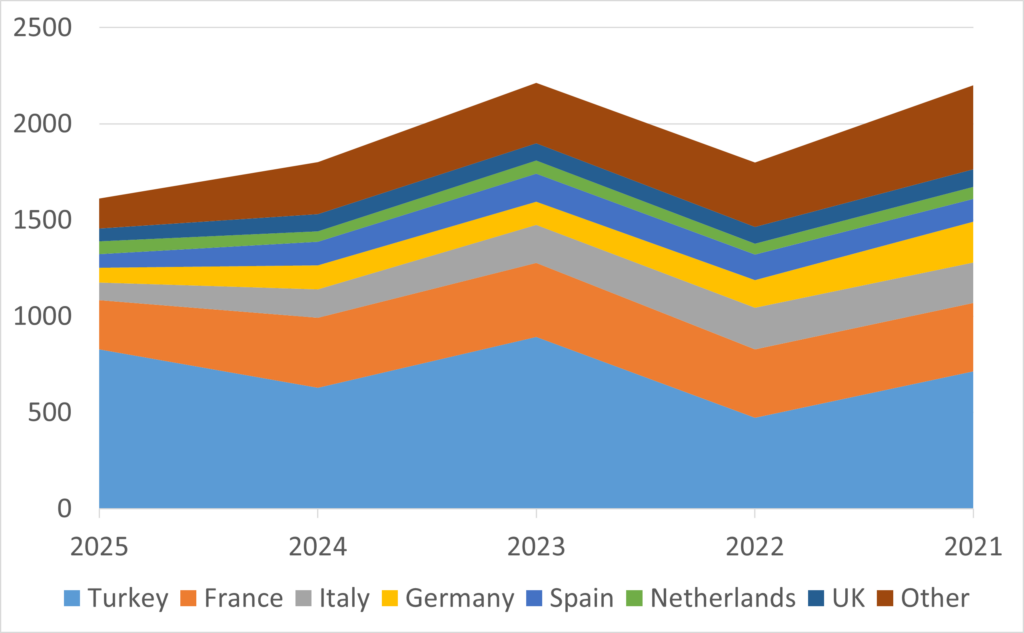
Between 2016 and 2025, trademark infringement litigation in Europe underwent a dramatic transformation. In 2016, European courts recorded approximately 2,686 trademark infringement decisions across the seven most active jurisdictions. By 2025, that figure had fallen to around 1,611 — a decline of roughly 40%. At first glance this might suggest that trademark infringement is becoming less common. The reality is more nuanced: litigation patterns have shifted, enforcement strategies have evolved, and the rise of out-of-court enforcement mechanisms — including platform takedowns, customs seizures, and negotiated settlements — has reduced the number of disputes that reach a formal court decision.
But within that overall decline, the distribution of cases across countries has changed profoundly, and the shifts reveal a great deal about how trademark enforcement is actually functioning across the continent.
Turkey — Europe’s Trademark Litigation Powerhouse
The most dramatic change in the European trademark litigation landscape over the past decade has been the rise of Turkey. In 2016, Turkish courts recorded approximately 265 trademark infringement decisions — placing Turkey well behind France, Germany, and Italy. By 2025, that figure had surged to 829 decisions, making Turkey by far the most active trademark litigation jurisdiction in Europe, accounting for more than half of all European trademark court decisions in that year alone.
This is a remarkable shift that reflects several converging factors: Turkey’s large and rapidly growing consumer market, its significant manufacturing base in sectors prone to trademark infringement such as textiles and consumer goods, the relative accessibility and affordability of its court system, and the maturation of a local IP enforcement culture following the introduction of the Industrial Property Code No. 6769 in 2017.
France — The Consistent European Leader
While Turkey leads on volume, France has long been and remains the most important European jurisdiction from the perspective of obtaining meaningful financial compensation for trademark infringement. French courts recorded approximately 255 trademark decisions in 2025 — second only to Turkey in volume — but France’s significance goes far beyond case numbers. The structure of French proceedings, the power of France’s unique evidence-gathering tool — the saisie-contrefaçon — and the French courts‘ consistent approach to awarding damages including moral prejudice as a standalone component, make France the jurisdiction where rights holders are most likely to obtain a substantial, quantified financial award in a single set of proceedings.
The Darts-IP data on damages awarded consistently shows France generating more damage awards than any other European country. In 2025, France accounted for over 50% of all European damage awards captured in the database, and in 2016 the picture was similar: out of approximately 350 total European damage awards recorded, France accounted for around 164. This dominance is structural, not accidental.
Germany — High Volume, Different Structure
Germany recorded approximately 78 trademark decisions in 2025 — a significant decline from its 2016 figure of around 325. Germany appears relatively modestly in the Darts-IP damage award statistics, with approximately 11 awards recorded in 2025 compared to 35 in 2016. However, this figure almost certainly represents one of the most significant undercounts in the dataset. In Germany, the question of whether a defendant is liable and the question of how much they must pay are decided in separate court proceedings. Germany remains one of Europe’s most sophisticated and heavily used trademark enforcement jurisdictions — it simply works differently from France.
Italy — Strong Enforcement, Structural Undercounting
Italy recorded approximately 91 trademark decisions in 2025, down from 198 in 2023 and 281 in 2016. Italian law allows preliminary injunctions to become permanent without ever proceeding to a full merits judgment, meaning a significant proportion of Italian trademark disputes are resolved definitively at the interim stage, without generating a decision that contains a financial award. Italy is, in reality, a jurisdiction with strong and well-resourced IP enforcement, particularly through its specialised IP sections in Milan, Turin, and Rome.
Spain — An Underrated Enforcement Jurisdiction
Spain recorded approximately 69 trademark decisions in 2025. Spain’s damage award numbers are more visible in the Darts-IP data than Germany’s or Italy’s, with approximately 19 awards recorded in 2025 compared to 36 in 2016. This reflects in part Spain’s single-proceeding structure, under which liability and a quantum of damages can be determined in the same judgment. Spain has developed a sophisticated network of specialist Commercial Courts, and the EU Trademark Court in Alicante gives it a unique position in the European enforcement landscape for EU-wide trademark protection.
The Netherlands — Small Volume, Strategic Significance
The Netherlands is the outlier in these statistics in an instructive way. Dutch courts recorded only around 67 trademark decisions in 2025 — among the lowest in the group — yet the Netherlands consistently appears in the damage award data, with approximately 17 awards recorded in 2025. The Netherlands‘ significance in European trademark enforcement is completely invisible in case volume statistics. The dominant Dutch enforcement tool — the kort geding, or summary injunction proceeding — is fast, inexpensive, and covers the entire Benelux territory in a single decision.
The United Kingdom — Sophisticated but Structurally Invisible
The United Kingdom recorded approximately 66 trademark decisions in 2025. The UK’s damage award numbers in the Darts-IP data are low — and almost certainly represent the most severe undercount of all seven jurisdictions covered in this article. Like Germany, the UK operates a strict bifurcation between the liability trial and the subsequent quantum enquiry. The UK is home to some of Europe’s most commercially significant trademark litigation, including cases involving luxury goods, fashion, and technology brands. The data simply does not capture it.
What the Numbers Really Tell Us
Taken together, the Darts-IP data paints a picture that is simultaneously informative and misleading. The countries that appear strongest in the damage award statistics — France and Spain — are the ones where procedural structure makes awards visible in first-instance decisions. The countries that appear weakest — Germany, the UK, Italy, and the Netherlands — are often the ones where structural features of national procedure mean that financial compensation, when it is awarded, is awarded elsewhere.
| Country | Cases 2025 | Cases 2016 | Damage Awards 2025 | Damage Awards 2016 |
|---|---|---|---|---|
| Turkey | 829 | 265 | 5 | — |
| France | 255 | 822 | 81 | 164 |
| Italy | 91 | 281 | 8 | 49 |
| Germany | 78 | 325 | 11 | 35 |
| Spain | 69 | 119 | 19 | 36 |
| Netherlands | 67 | 86 | 17 | — |
| UK | 66 | 59 | — | — |
| Total | 1,611 | 2,686 | 160 | 350 |
Source: Darts-IP. Figures reflect decisions captured in the database and are subject to the methodological limitations discussed above. A dash (—) indicates data not captured for that year. Only court cases related to trademark infringement are reflected.
| Country | 2021 | 2022 | 2023 | 2024 | 2025 |
|---|---|---|---|---|---|
| Turkey | 713 | 473 | 893 | 629 | 829 |
| France | 357 | 355 | 384 | 364 | 255 |
| Italy | 209 | 217 | 198 | 146 | 91 |
| Germany | 212 | 143 | 120 | 126 | 78 |
| Spain | 118 | 132 | 146 | 122 | 69 |
| Netherlands | 63 | 56 | 69 | 54 | 67 |
| UK | 91 | 88 | 88 | 90 | 66 |
| Total | 2,200 | 1,799 | 2,213 | 1,801 | 1,611 |
Notable Cases of Trademark Infringement in Europe
Deutsche Telekom AG v. Telefónica Germany GmbH & Co. OHG
Higher Regional Court of Hamburg, 29 September 2022 — Az. 5 U 91/21
When Telefónica unveiled a major corporate rebranding in 2021 — introducing a stylised „T“ composed of five dots as its new visual identity — Deutsche Telekom immediately sought a preliminary injunction in Hamburg. The Higher Regional Court granted it, confirming that Telefónica’s new sign infringed Telekom’s well-known „T“ trademark under both the likelihood of confusion standard and the reputation protection route of Art. 9(2)(c) EUTMR. The case is a striking demonstration of how fast and effective German preliminary injunction proceedings can be: a major global telecommunications company’s entire rebranding campaign was halted within weeks.
BGH — PIERRE CARDIN
Federal Court of Justice, 22 February 2024 — I ZR 217/22, GRUR 2024, 543
The German Federal Court of Justice (BGH) addressed the conditions for obtaining publication of an infringement judgment under § 19c MarkenG. The exclusive licensee of the EU trademark PIERRE CARDIN had established through test purchases that a major retail chain operating approximately 300 stores nationwide was repeatedly selling PIERRE CARDIN-branded socks without authorisation. The BGH clarified that the statutory publication remedy is available even where significant time has passed since the infringing acts, provided ongoing market confusion can be demonstrated.
BGH — DACHSER
Federal Court of Justice, 12 January 2023 — I ZR 86/22, GRUR 2023, 808
The BGH held that a scale model toy manufacturer did not infringe DACHSER’s well-known trademark by reproducing, in faithful miniature, DACHSER-branded lorries and warehouse buildings. The Court confirmed that the decades-long tradition of detailed model making creates a legitimate interest in reproducing real-world vehicles and buildings including their real-world markings. The decision clarifies the boundary between actionable free-riding on a famous trademark’s goodwill and permissible realistic reproduction.
Lidl Great Britain Limited & Ors v. Tesco Stores Limited & Ors
High Court — [2023] EWHC 873 (Ch); Court of Appeal — [2024] EWCA Civ 262
One of the most commercially significant UK trademark decisions of the decade. Lidl successfully argued that Tesco’s Clubcard Prices promotional logo infringed its registered trademark under section 10(3) of the Trade Marks Act 1994, taking unfair advantage of Lidl’s reputation for low prices. The case sent a powerful signal to retailers about the limits of lookalike design strategies and has directly influenced how supermarket own-brand promotional materials are designed.
Thatchers Cider Company Limited v. Aldi Stores Limited
Court of Appeal — [2025] EWCA Civ 5, 20 January 2025
The Court of Appeal overturned the first-instance IPEC judgment and found that Aldi had infringed Thatchers‘ UK registered trademark for its Cloudy Lemon Cider packaging. The court concluded that Aldi had intentionally designed its product to remind consumers of Thatchers‘ product — conveying the message that the Aldi product was „like the Thatchers product, only cheaper.“ Internal Aldi documents showing that Thatchers was used as the sole design benchmark proved decisive. The case has become the leading authority on how intentional „benchmarking“ constitutes actionable unfair advantage.
SkyKick UK Limited and another v. Sky Limited and others
UK Supreme Court — [2024] UKSC 36, 13 November 2024
The UK’s most important trademark validity decision in a generation. The Supreme Court established that the overall width and scope of a trademark specification, relative to the applicant’s actual business, can give rise to an inference of bad faith — and that an applicant who deliberately files for broad coverage to deploy registrations as a „legal weapon“ against competitors acts outside the proper purposes of the trademark system. The ruling has immediate practical implications for every brand owner maintaining broad trademark registrations in the UK.
Céline SAS v. Mango France SAS & Punto Fa SL
Court of Appeal of Paris, Pôle 5, Ch. 2, 10 November 2023 — n° 21/19126
The Paris Court of Appeal awarded €2,000,000 in total compensation to luxury fashion house Céline against Spanish fast-fashion retailer Mango, finding systematic acts of commercial parasitism (parasitisme commercial). The Court found that Mango had repeatedly and systematically copied key pieces from Céline’s collections in a pattern demonstrating a deliberate strategy to free-ride on Céline’s creative investment and luxury brand reputation.
Juventus F.C. S.p.A. v. Blockeras S.r.l.
Court of Rome — Tribunale di Roma, 20 July 2022, No. 32072/2022
The first European court decision on trademark infringement through NFTs. Juventus Football Club obtained a preliminary injunction against Blockeras, which had minted and sold NFT digital trading cards on Binance bearing the Juventus club trademarks without authorisation. The Court of Rome held that the commercial use of Juventus‘ trademarks on NFTs without consent constituted trademark infringement, setting the foundational framework for NFT trademark enforcement in Italy.
Basic Trademark S.A. (KAPPA) v. Karin S.r.l.
Court of Milan, IP Specialised Section, 17 April 2023
The Milan Specialised IP Section awarded €355,777.62 in damages for infringement of the well-known KAPPA trademark family. The case is particularly significant for its damages methodology: the court applied the reasonable royalty method (canone di licenza), guided by a detailed court-appointed technical expert (CTU) process, making the decision a valuable precedent for royalty-based trademark damage calculations in Italy.
Court of Milan — Diesel/Inditex: Parent Company Liability
Court of Milan, IP and Company Specialised Division, 5 July 2022
A landmark judgment confirming that a parent company can be held directly liable — both for damages and for profit disgorgement — arising from trademark infringement committed by its subsidiaries. The case has major implications for cross-border trademark enforcement against multinational groups operating through subsidiary structures.↑ Back to Table of Contents
What is Trademark Infringement?
The Foundation — What a Trademark Is and What It Does
A trademark is a sign that distinguishes the goods or services of one business from those of another. It can be a word, a name, a logo, a colour combination, a shape, a sound, or any other sign capable of being represented clearly and of performing this distinguishing function in the marketplace. The trademark system exists for two reasons that reinforce each other: it protects the investment that businesses make in building recognisable, trusted brands, and it protects consumers from being misled about the origin of the goods and services they purchase.
A registered trademark grants its owner the exclusive right to use that mark — or any sign confusingly similar to it — in connection with the goods and services for which it is registered, within the territory where the registration is valid.
The Core Concept — Likelihood of Confusion
The central and most commonly encountered form of trademark infringement is the unauthorised use of a sign that creates a likelihood of confusion among consumers. This is the standard that applies in every European jurisdiction covered in this article. Likelihood of confusion does not mean that consumers are actually confused — it means that there is a realistic risk that they could be. Courts assess this risk by reference to a composite assessment of multiple factors: the similarity of the signs, the similarity of the goods or services, the distinctiveness of the earlier trademark, the level of attention of the relevant consumer, and the degree of recognition of the earlier mark.
Crucially, likelihood of confusion includes the likelihood of association — the risk that a consumer, even if not directly confused about origin, might assume that there is an economic link, a licensing relationship, or some form of official connection between the two businesses.
When No Confusion Is Required — Protection of Well-Known and Reputed Marks
Where a trademark enjoys a reputation — meaning it is known to a significant proportion of the relevant public — its owner can prevent third parties from using a similar or identical sign even in connection with completely different goods or services, provided that use takes unfair advantage of, or is detrimental to, the distinctive character or the repute of the trademark. This covers three specific forms of harm: free-riding, dilution or blurring, and tarnishment.
The Requirement of Trademark-Like Use — In the Course of Trade
Not every use of a sign that resembles a trademark constitutes infringement. For infringement to exist, the use must be „in the course of trade“ and must be „trademark-like“ — used as a badge of origin rather than purely as a decorative element or a descriptive reference. Private, non-commercial use of a sign does not constitute trademark infringement.
Counterfeiting — The Most Serious Form of Infringement
Counterfeiting is a distinct and aggravated category of trademark infringement. A counterfeit uses an identical or virtually indistinguishable copy of a registered trademark, applied to goods designed to pass themselves off as genuine branded products. The legal consequences of counterfeiting are consistently more severe than those of standard trademark infringement across all jurisdictions: criminal prosecution is more readily available, financial penalties are higher, and the evidentiary threshold is lower.
False Advertising and Comparative Advertising
Comparative advertising — advertising that explicitly identifies a competitor by name or by their trademark — is permitted in the EU under specific conditions set out in the Comparative Advertising Directive 2006/114/EC. Comparative advertising that exceeds these boundaries can constitute both an unfair commercial practice and a trademark infringement.
Cybersquatting and Domain Name Infringement
Cybersquatting — the practice of registering domain names that incorporate or closely resemble established trademarks — is one of the most prevalent forms of online brand abuse. The legal response operates on two parallel tracks: the UDRP of ICANN for fast administrative proceedings, and national courts for trademark infringement claims with injunctions and damages.↑ Back to Table of Contents
The Legal Framework — How Trademark Rights Are Protected in Europe
The European Union Level — Two Parallel Systems
The EU has created two parallel systems for trademark protection. The EU Trademark (EUTM), governed by Regulation (EU) 2017/1001, is a single registration valid across all 27 EU member states simultaneously. The core infringement provision is Article 9 EUTMR. However, the EUTMR does not create a unified remedy for infringement — financial compensation is still calculated under national law of the hearing court. The same EUTM infringement, litigated in different national EU Trademark Courts, can produce dramatically different financial outcomes.
National Trademark Systems — Parallel Protection
Alongside the EUTM system, each member state maintains its own national trademark system, now substantially harmonised by EU Trademark Directive 2015/2436. What differs dramatically between countries is not the definition of infringement but the procedural rules, evidence-gathering tools, court structures, and damage calculation methods.
The International Level — TRIPS and the Paris Convention
All EU member states, Turkey, and the United Kingdom are parties to the TRIPS Agreement and the Paris Convention for the Protection of Industrial Property. The Madrid Protocol provides an international filing system through which a trademark owner can obtain protection in multiple countries through a single international application.
The EU Enforcement Directive — The Key Instrument for Damages
Directive 2004/48/EC on the Enforcement of Intellectual Property Rights (IPRED), adopted on 29 April 2004, is the central EU-level instrument governing civil enforcement of IP rights across member states. Its core damages provision, Article 13, requires courts to award damages appropriate to the actual prejudice suffered, taking into account negative economic consequences, unfair profits made by the infringer, and — in appropriate cases — moral prejudice. As an alternative, courts may award a lump sum based on at least the royalties or fees that would have been due for a legitimate licence. IPRED is a minimum harmonisation instrument only — member states are free to go further.
The German National Framework
The Markengesetz (MarkenG) is the primary German legislation. § 14(6) MarkenG establishes the right to claim damages and requires fault (intent or negligence). § 19 MarkenG provides the information and disclosure right. § 140 MarkenG grants exclusive first-instance jurisdiction to the Regional Courts, making mandatory legal representation always required. Germany has designated 21 specialist trademark courts, with the great majority of significant litigation concentrated in Cologne, Düsseldorf, Frankfurt, Hamburg, and Munich.
The United Kingdom Post-Brexit — A Diverging Framework
Since 1 January 2021, the United Kingdom operates an entirely independent trademark system under the Trade Marks Act 1994 (TMA). UK courts are no longer bound by CJEU decisions on trademark law. All existing EU trademarks were automatically converted into equivalent UK comparable trademarks on exit day, but going forward, brand owners require both an EUTM and a separate UK trademark registration for full coverage of both markets.↑ Back to Table of Contents
Types of Trademark Infringement Damages
Lost Profits — The Most Direct Measure of Harm
Lost profits represent the most straightforward category: the money the rights holder would have earned had the infringement not occurred. The practical challenge is formidable — establishing lost profits with the precision that courts require demands proof of the volume of infringing sales, the carry-over rate, the price at which the rights holder would have sold, and the margin they would have achieved. Courts require more than assertion: they require evidence including market studies, sales data, capacity analysis, and expert economic testimony.
Disgorgement of the Infringer’s Profits — Taking Away the Gain
Disgorgement of the infringer’s profits focuses on what the infringer gained rather than what the rights holder lost, ensuring that infringement is never commercially profitable. In Germany, Italy, and the Netherlands, profit disgorgement is available as an independent alternative remedy. In France, the infringer’s profits are primarily a component of the rights holder’s overall damages assessment.
The Fictitious Licence Fee — The European Practitioner’s Default
The fictitious or hypothetical licence fee — known in German practice as the Lizenzanalogie — is the most widely used damage calculation method in European trademark practice. The concept: if the infringer had approached the rights holder and asked for permission to use the trademark, what licence fee would the parties have agreed? Courts look at comparable licensing agreements, industry benchmarks, the distinctiveness and recognition of the trademark, the scope and duration of the infringing use, and expert evidence from IP valuation specialists.
Reasonable Royalty — The US Equivalent and Its European Cousins
The reasonable royalty concept in US law is closely related to the European licence fee analogy. In European practice, the analytical framework is substantially similar: what would a willing licensor and willing licensee have agreed at arm’s length, on the date infringement began, for the specific use made by the infringer?
Nominal and Symbolic Damages — When Infringement Is Clear but Harm Is Not
Nominal or symbolic damages are available in some jurisdictions where infringement has been clearly established but actual financial harm is minimal or impossible to quantify. The EU Enforcement Directive’s royalty floor — that damages must be at least equivalent to a reasonable licence fee — effectively functions as a floor that prevents European courts from awarding purely nominal sums in most cases.
Punitive, Aggravated, and Exemplary Damages — Europe’s Missing Category
Punitive damages do not exist in trademark law in any of the seven jurisdictions covered in this article. The EU Enforcement Directive explicitly states that the damages system it mandates is compensatory in nature. Where willfulness does matter in European law is in its effect on the quantum of compensatory damages — every component of the compensatory assessment is calibrated toward the higher end of the available range.
Treble Damages — A US Concept Without European Equivalent
Treble damages under the US Lanham Act — the mandatory tripling of the award in cases of willful infringement — have no equivalent anywhere in European trademark law. European trademark law is strictly compensatory. A trademark infringement that would produce a €500,000 compensatory award in a European court might produce $1.5 million or more in a US court through the treble damages multiplier.
Statutory Damages — Fixed Compensation for Counterfeiting
Statutory damages in the US form do not exist in European trademark law. No EU member state covered in this article provides a pre-set statutory damages range equivalent to the US Lanham Act provision. The closest approximation is the EU Enforcement Directive’s royalty floor. European jurisdictions address the evidential problem of counterfeiting through other mechanisms: France’s saisie-contrefaçon, Germany’s information right, Italy’s descrizione, and criminal prosecution.
Moral and Non-Pecuniary Damages — Compensation for Reputational Harm
Moral or non-pecuniary damages compensate for harm to the trademark’s image, reputation, and prestige that cannot be reduced to a specific financial loss. French law treats moral prejudice (préjudice moral) as a mandatory, standalone component of every trademark damages award. Italian courts apply an informal but consistent rule of thumb of awarding moral damages at 50% of the assessed pecuniary damage. German law, by contrast, does not recognise a separate moral damage component.
Corrective Advertising Costs — Undoing the Confusion
Corrective advertising costs — reasonable, documented expenditures to counteract the consumer confusion created by trademark infringement — are recoverable in most European jurisdictions as a component of the rights holder’s actual losses, provided they are shown to be genuinely necessary and proportionate to the harm caused.
Loss of Goodwill — The Long-Term Brand Damage
Loss of goodwill represents perhaps the most commercially significant but most difficult to quantify category of trademark damage. Goodwill — the accumulated commercial value of a brand — can be damaged by infringement in ways that persist long after the infringement has ceased. Loss of goodwill is recoverable in all European jurisdictions as a component of the rights holder’s actual losses, but requires sophisticated valuation methodology and credible expert evidence.↑ Back to Table of Contents
Prerequisite Conditions for Claiming Trademark Damages
The Fault Requirement — Intent, Negligence, and Innocence
The most fundamental prerequisite condition for a damages claim in European trademark law is fault — the requirement that the infringer acted either intentionally or negligently. Germany requires fault strictly but treats failure to conduct a clearance search as negligence. Italy applies a similar fault framework but allows profit disgorgement even against completely innocent infringers. France takes the most rights-holder-friendly approach: civil trademark infringement in France requires no fault whatsoever. Spain operates a two-tier fault system. Turkey requires fault in principle but provides an equitable fallback.
The Harm Requirement — Damage Must Have Occurred
The rights holder must have actually suffered harm from the infringement. European trademark law does not award financial compensation as a purely abstract acknowledgment of infringement. The CJEU addressed this requirement in Case C-481/14 (Hansson, 2016), clarifying that even where the lump-sum licence fee method is used, the rights holder must still demonstrate that some actual prejudice was suffered.
The Causation Requirement — Linking the Infringement to the Loss
The rights holder must prove a causal link between the specific infringing conduct and the specific financial loss claimed. It is not sufficient to show that the rights holder suffered financial losses during the period of infringement — the losses must be shown to have been caused by the infringement. The licence fee analogy and profit disgorgement methods are partly attractive in practice because they sidestep the causation problem to a significant degree.
The Proof Standards — No Speculation, But Equitable Assessment Is Permitted
European courts universally require that damages claims be supported by evidence that goes beyond speculation. At the same time, all major European jurisdictions empower courts to make an equitable assessment of damages where the fact of damage is proven but its precise quantum cannot be established with mathematical precision. German courts apply judicial estimation (richterliche Schätzung) under § 287 ZPO; French courts exercise broad equitable discretion; Italian courts may instruct a CTU even where evidence is incomplete.
The Burden of Proof — Who Must Prove What
The rights holder must establish the fact of infringement and the basis of the damages claim — including the infringer’s revenues under the profit disgorgement method. The infringer bears the burden of proving any costs or deductions they claim should be subtracted from revenues to arrive at net profit. If the infringer cannot substantiate their claimed costs, courts will typically award damages based on the gross revenues established by the rights holder.
Willfulness and Its Role — Enhanced Consequences Without Punitive Damages
While European trademark law does not award punitive damages, willfulness operates as a quantum amplifier within the compensatory framework, pushing every element of the damages assessment toward the upper end of the range. In the Netherlands, willfulness has the specific additional consequence of allowing compensatory damages and profit disgorgement to be awarded cumulatively rather than as alternatives — the closest that any European jurisdiction comes to the US treble damages concept.
The Limitation Periods — Acting Before the Window Closes
Each jurisdiction has its own limitation rules. France: 5 years from the date of knowledge of the last infringing act. Germany: 3 years standard; 10 years for unjust enrichment claims under § 852 BGB. UK: 6 years under the Limitation Act 1980. Italy and Spain: 5 years from the date of knowledge. Netherlands: 5 years for damages; 20-year general period for infringement proceedings. Turkey: 2 years from the date of knowledge; 10-year absolute period.↑ Back to Table of Contents
Factors Courts Consider When Assessing Damages
The EU Enforcement Directive, in Article 13, requires courts to take into account „all appropriate aspects“ when assessing damages. The most important factors, applied across all seven jurisdictions, include: duration of the infringement — how long the infringing activity persisted; extent, scale, and intensity — the commercial footprint of the infringement; lost profits of the injured party; profits earned by the infringer; the hypothetical royalty as a market benchmark; intent of the infringer — willful, negligent, or innocent; degree of fault and mala fide conduct; mitigation; consequences for the rights holder’s reputation; prior history of infringement; public interest and safety; and market share diverted from the rights holder to the infringer.↑ Back to Table of Contents
The Role of the Information and Disclosure Claim
The right to information is not a peripheral procedural nicety — it is the structural bridge between establishing liability and obtaining meaningful financial compensation. The legal basis is Article 8 of the EU Enforcement Directive (IPRED). The rights holder cannot know how much they are owed until they know what the infringer actually did. The information right compels disclosure of the identity of all parties in the infringing supply chain, quantities of infringing goods, prices charged, revenues generated, and costs and expenses attributable to the infringing activity.
Consequences of non-compliance include adverse inferences, financial penalties (the Dutch dwangsom, French astreinte, UK contempt), criminal liability for deliberately providing false information, and procedural consequences. The fundamental principle: evasion of disclosure obligations does not amount to escape from financial liability.↑ Back to Table of Contents
Attorney Fees and Litigation Costs
The European legal basis for legal costs recovery is Article 14 of the EU Enforcement Directive (IPRED), which requires that reasonable and proportionate legal costs incurred by the successful party shall, as a general rule, be borne by the unsuccessful party. In practice, the gap between actual costs incurred and costs recovered from the losing party is a consistent feature across most jurisdictions. The exception is the Netherlands, which has implemented Article 14 on a full-indemnity basis through Article 1019h of the Dutch Code of Civil Procedure.
For cease-and-desist letter costs: in the majority of European jurisdictions, the cost of preparing a properly drafted cease-and-desist letter is recoverable from the infringer as a direct consequence of their infringing conduct.↑ Back to Table of Contents
Willful, Negligent, and Innocent Infringement — Why Intent Matters
Innocent infringement occurs where the infringer had no knowledge of the earlier trademark and acted in complete good faith. It is increasingly difficult to establish in practice. Where it is genuinely established, the financial consequences are the most limited — typically only injunctive relief.
Negligent infringement — by far the most commonly encountered category — covers the broad middle ground where the infringer failed to exercise the care a reasonably competent commercial operator would have exercised. Failure to conduct a trademark clearance search is the paradigmatic example. Negligent infringement triggers full damages liability across all European jurisdictions that impose a fault requirement.
Willful infringement — the most serious category — covers deliberate, knowing misappropriation. It triggers the most severe financial and legal consequences. Every component of the damages assessment is affected: higher hypothetical royalty rates, more rigorous profit assessment, elevated moral damage components, and in France, Germany, Italy, Spain, and the UK — criminal prosecution.↑ Back to Table of Contents
Counterfeiting as a Special Case
Counterfeiting is not merely a more serious form of trademark infringement — it is a categorically different phenomenon that combines trademark violation with consumer fraud, frequently involves organised criminal networks, and causes harm extending to public safety, consumer welfare, and the integrity of commercial markets.
The EU’s legal response operates on multiple levels: IPRED for civil enforcement; EU Regulation 2013/608 (Border Measures Regulation) enabling customs authorities to detain suspect goods; and the Digital Services Act (DSA) imposing obligations on online platforms. The migration of counterfeit goods sales to online marketplaces is the most significant structural change in European counterfeiting over the past decade.↑ Back to Table of Contents
Practical Enforcement Steps and Strategy
Step 1 — Trademark Monitoring: Systematic watching of trademark applications, the commercial marketplace, customs, and domain names. The earlier an infringement is detected, the stronger the urgency argument for interim relief.
Step 2 — Assessment: Careful, objective assessment of whether infringement actually exists before any formal enforcement step is taken.
Step 3 — The Cease-and-Desist Letter: The standard first formal enforcement step. It puts the infringer on formal notice, creates a documented record, establishes the rights holder’s costs as a recoverable item, and opens the possibility of settlement.
Step 4 — Preliminary Injunction: The most powerful immediate enforcement tool. Urgency is the critical threshold condition. Acting immediately upon confirmed discovery of infringement is legally essential — delay defeats the urgency argument.
Step 5 — Protective Letters: A pre-emptive filing by potential defendants in jurisdictions like Germany, setting out arguments against a preliminary injunction application before it is filed.
Step 6 — Information and Discovery: Compelling the infringer to produce the financial data needed to calculate damages. This phase requires careful coordination between legal proceedings and financial analysis.
Step 7 — Damage Quantification: The strategic choice of calculation method — lost profits, profit disgorgement, or licence fee analogy — must be made and committed to. Expert evidence is typically required.
Step 8 — Settlement: Statistically the most likely outcome. Settlement avoids cost, uncertainty, and time while delivering a certain financial outcome sooner and with lower total costs than a fully litigated judgment.
Step 9 — Full Litigation: Where settlement fails. The decision to proceed to full judgment should be made on the basis of expected outcome, total costs, and the strategic value of a public judgment as a deterrent.↑ Back to Table of Contents
Why Trademark Protection and Damages Matter — A Business Perspective
For the overwhelming majority of consumer-facing businesses, the trademark is among the most valuable assets on the balance sheet. Trademark infringement causes damage to brand value and goodwill — gradual undermining of the consumer trust that the rights holder has invested years in building. It causes loss of sales through diversion to the infringer, including a „springboard effect“ through which the competitive advantage gained persists even after infringement ceases. It causes consumer confusion that undermines the fundamental trust relationship between a brand and its customers. It causes reputational damage from poor quality counterfeits that consumers attribute to the genuine brand. And in its most severe forms, it creates genuine public safety risks that elevate enforcement from a commercial matter to a matter of consumer welfare.
The businesses that experience the most commercially damaging trademark infringement are almost invariably those that underinvested in trademark protection during the period when their brand was being built. The most effective trademark strategy is not reactive enforcement but proactive protection.↑ Back to Table of Contents
Trademark Damages by Country
Most of the seven countries covered in this article share a common legal foundation — the EU’s Intellectual Property Enforcement Directive — and yet what happens in practice when a trademark owner walks into a courtroom in Paris, Munich, London, Milan, Madrid, Amsterdam, or Istanbul could not be more different. The sections below explain exactly why — country by country, in the detail that any serious brand owner needs to understand before deciding where and how to enforce their rights.
The EU Efforts
The EU’s central instrument for harmonising IP enforcement is Directive 2004/48/EC (IPRED). Its key damages provision — Article 13 — requires courts to take into account all appropriate aspects when calculating compensation. However, IPRED is a minimum harmonisation instrument only, per Article 2(1). The words „all appropriate aspects“, „in appropriate cases“, and „reasonable and proportionate“ are invitations for national courts to interpret the rules in light of their own traditions.
The CJEU has attempted to fill some gaps: in Liffers (C-99/15, 2016), moral prejudice damages were confirmed as claimable in addition to a lump-sum royalty award. In OTK (C-367/15, 2017), the Court confirmed that the lump-sum royalty can be set at double the hypothetical royalty rate under national law. Despite over two decades of EU legislative effort, there is no genuinely unified European approach to trademark damages. The same trademark infringement case can produce a six-figure damages award in one jurisdiction and nothing quantifiable in another.↑ Back to Table of Contents
Trademark Damages in Germany
Germany is one of the world’s most sophisticated trademark enforcement jurisdictions. Yet it appears to produce few damage awards in databases — approximately 11 in 2025 out of 78 total trademark decisions. The explanation is structural: German trademark litigation unfolds in two entirely separate sets of proceedings.
The first proceeding establishes liability, grants an injunction, and issues a declaratory judgment confirming liability to pay damages — but specifies no amount. It also orders the infringer to provide detailed information and accounts under § 19 MarkenG. The second proceeding — which begins after the infringer has complied — is where the actual monetary award is determined.
The legal basis for damages is § 14(6) MarkenG. Both intent and negligence suffice; pure innocent infringement does not give rise to a damages claim. The rights holder may choose one of three calculation methods: (1) concrete lost profits; (2) disgorgement of the infringer’s profits (Gewinnherausgabe); or (3) fictitious licence fee (Lizenzanalogie) — by far the most commonly used. Germany does not award punitive damages.
Germany’s injunction machinery is among the fastest and most powerful in Europe — a preliminary injunction (einstweilige Verfügung) can be obtained within one to three weeks, often without the defendant being heard. Violations carry fines of up to €250,000 per violation under § 890 ZPO. Intentional trademark infringement is a criminal offence under §§ 143–144 MarkenG, punishable by up to 5 years‘ imprisonment for commercial-scale infringement.
Limitation periods: 3 years standard; 10 years for unjust enrichment under § 852 BGB. First-instance proceedings: 12 to 24 months; total time to a final quantified damages award in a contested case: 3 to 5 years.↑ Back to Table of Contents
Trademark Damages in the United Kingdom
The UK is home to some of Europe’s most commercially significant trademark litigation, yet produces almost no recorded damage awards — the most severe undercount of all seven jurisdictions, due to both mandatory bifurcation and near-universal settlement after the liability trial.
The governing legislation is the Trade Marks Act 1994 (TMA). The rights holder must make a fundamental binary choice after liability is established: either damages (lost profits, notional licence fee, damage to goodwill, corrective advertising costs) or account of profits (disgorgement of the infringer’s actual profits) — but not both, and the choice is irrevocable. Damages can be recovered from the date of the trademark application, not only from registration.
The UK’s dual court system is unique in Europe. The High Court (Chancery Division) handles high-value complex disputes with no cap on damages or costs. The Intellectual Property Enterprise Court (IPEC) provides cost-controlled access for SMEs, with a damages cap of £500,000 and a costs cap of £60,000 + £30,000 for the two stages. The unjustified threats regime under sections 21–21F TMA makes threatening secondary actors such as retailers an actionable civil wrong if the threat turns out to be unjustified.
Criminal penalties under Section 92 TMA are among Europe’s harshest: up to 10 years‘ imprisonment. Limitation period: 6 years under the Limitation Act 1980.↑ Back to Table of Contents
Trademark Damages in France
France is the undisputed leader in European trademark damages enforcement. In 2025, France accounted for approximately 81 out of 160 total European trademark damage awards captured by Darts-IP — over 50% of the entire European total.
Two structural features explain France’s dominance. First, French courts determine liability and damages in a single set of proceedings — every successful French trademark case generates a publicly recorded damage figure. Second, France possesses the saisie-contrefaçon — an ex parte procedure authorised by a judge, carried out by a bailiff without advance notice, that allows the seizure and copying of accounting documents, sales invoices, stock lists, and customer records at the infringer’s premises before they have any opportunity to prepare.
The governing legislation is the Code de la Propriété Intellectuelle (CPI), with damages governed by Article L.716-4-10 CPI. Crucially, French civil trademark infringement requires no fault whatsoever — the act of infringement itself establishes civil liability. Courts assess three distinct components of damage: (1) negative economic consequences (conséquences économiques négatives); (2) moral prejudice (préjudice moral) — a mandatory, standalone component of every award; and (3) infringer’s profits including savings on promotional investments. Criminal penalties reach up to 4 years‘ imprisonment and €400,000 in fines for individuals. Limitation period: 5 years from the date of knowledge of the last infringing act.↑ Back to Table of Contents
Trademark Damages in Turkey
Turkey is the most paradoxical trademark enforcement jurisdiction in Europe. With approximately 829 trademark infringement decisions in 2025 — over half of all European trademark court decisions — it produces only approximately 5 recorded damage awards. The explanation is structural: the majority of infringing goods in Turkey are sold without invoices, without formal accounting records, and without any paper trail that a court could use to calculate damages.
The governing legislation is Industrial Property Code No. 6769 (in force since 10 January 2017). Notably, the 2017 reform abolished criminal liability for trademark infringement entirely — trademark disputes are now handled exclusively through civil courts.
Three damage calculation methods are available under Article 149: (A) lost profits; (B) disgorgement of infringer’s net profits; (C) hypothetical licence fee. Turkey additionally recognises three separate heads of compensation: pecuniary damages, non-pecuniary damages (manevi tazminat), and the uniquely Turkish reputation compensation (itibar tazminatı) for situations where the infringer used the trademark in an inferior manner.
Since 1 January 2019, mandatory mediation is a prerequisite before filing any civil lawsuit claiming monetary damages. Limitation period: 2 years from the date of knowledge; 10-year absolute period.↑ Back to Table of Contents
Trademark Damages in Italy
Italy’s damage award figures appear to have collapsed in the Darts-IP data — from approximately 49 awards in 2016 to just 8 in 2025 — but this reading is almost certainly wrong. Italy’s apparent decline reflects the structural feature that the most important and practically effective Italian enforcement tool — the preliminary injunction — frequently resolves disputes definitively without ever generating a publicly recorded damages figure, because under Article 132 CPI a preliminary injunction becomes permanent if neither party commences merits proceedings within the prescribed period.
The governing legislation is the Codice della Proprietà Industriale (CPI), with damages governed by Article 125 CPI. Italy’s distinctive approach to fault: where fault is absent, full compensatory damages are unavailable, but profit disgorgement remains available even against entirely innocent infringers — confirmed by the Court of Cassation (No. 21832/2021).
Three calculation methods are available: (1) full compensatory damages comprising actual loss, lost profits, and moral damage (the Milan Specialised IP Section applies an informal but consistent rule of thumb of awarding moral damages at 50% of the assessed pecuniary damage); (2) lump sum with royalty floor; (3) full profit disgorgement. Italy’s most powerful evidence-gathering tool is the descrizione — an ex parte procedure identical in concept to the French saisie-contrefaçon.
Criminal enforcement is active and relevant. Limitation period: 5 years from the date of knowledge of the infringement.↑ Back to Table of Contents
Trademark Damages in Spain
Spain is frequently underestimated in cross-border enforcement strategies, but offers important advantages: single-proceeding structure producing publicly recorded financial awards, the EU Trademark Court in Alicante with pan-European injunctive reach, and a legal framework that rewards well-prepared rights holders.
The governing legislation is Trademark Act (Ley de Marcas) No. 17/2001 as updated by Royal Decree-Law 23/2018. Spain operates a two-tier fault system: for ordinary registered trademarks, fault is generally required, but the cease-and-desist letter automatically converts any subsequent infringement into intentional conduct. For well-known or reputed trademarks, no fault is required at all.
Two calculation methods under Article 43: (A) negative economic consequences plus infringer’s profits plus moral damages, or (B) lump sum royalty equivalent. Always recoverable in addition to either option: investigation expenses — explicitly codified in Article 43 as a standalone recoverable item. Article 44 mandates a minimum daily penalty of €600 for every day of non-compliance with a cessation order. The Alicante EU Trademark Court can grant interim injunctions with EU-wide territorial effect covering all 27 member states. Criminal penalties reach up to 6 years‘ imprisonment for the most aggravated cases. Limitation period: 5 years.↑ Back to Table of Contents
Trademark Damages in the Netherlands
The Netherlands presents one of the most instructive paradoxes in European trademark enforcement. By case volume it is one of the smallest jurisdictions — approximately 67 trademark decisions in 2025 — yet by any measure of strategic importance, practical efficiency, and enforcement sophistication, it belongs in the first tier alongside France and Germany.
Trademark protection is governed by the Benelux Convention on Intellectual Property (BCIP), which creates a single trademark system covering the Netherlands, Belgium, and Luxembourg simultaneously. A single Dutch court injunction covers the entire Benelux territory as standard.
Two primary monetary remedies under Article 2.21(2) BCIP: (A) compensatory damages encompassing negative economic consequences, moral prejudice, and unfair profits; (B) surrender of profits as a separate independent claim. Where the infringer acted in bad faith, both remedies may be awarded cumulatively — the closest European equivalent to a punitive multiplier.
The Netherlands operates a clear two-track procedural system. The kort geding (summary proceedings) delivers a binding, Benelux-wide injunction in as little as a few days to six weeks, for approximately €5,000–€15,000 in attorney fees. The bodemprocedure (main proceedings) delivers financial compensation, taking approximately 6–12 months to a first-instance judgment. The dwangsom — periodic daily penalty — gives Dutch injunctions powerful financial teeth.
Legal costs recovery under Article 1019h DCCP is on a full-indemnity basis — the most favourable costs recovery system in Europe. Criminal enforcement of trademark rights is effectively non-existent in Dutch practice. Limitation periods: 5 years for damages; 20 years general period for infringement proceedings.↑ Back to Table of Contents
Practical Tips for Trademark Owners
Register First — Everything Else Depends on It
The single most important practical step any business can take is to register the trademark before you need to enforce it. Registration through the EUIPO as an EU Trademark provides protection across all 27 member states simultaneously. For the UK, Turkey, and other non-EU markets, separate national registrations or Madrid Protocol applications are needed. Registration should cover all relevant jurisdictions, classes, and brand elements — including word marks, logos, combined marks, and distinctive slogans.
Build and Maintain a Trademark Monitoring Programme
A trademark that is registered but not monitored is a lock without an alarm. Effective monitoring operates across register watching, market surveillance (physical and online), domain name monitoring, and customs recordal programmes. Professional monitoring services use automated tools and market intelligence capabilities that most internal teams cannot replicate — for any business with significant brand value, outsourced professional monitoring is standard infrastructure.
Act Immediately When Infringement Is Discovered
When you discover infringement, act immediately. The urgency imperative is legally essential: preliminary injunctions are conditional on the rights holder demonstrating urgency, and urgency is assessed by reference to the rights holder’s own conduct. Courts across all seven jurisdictions have dismissed technically meritorious preliminary injunction applications solely because the rights holder waited too long. Acting immediately means instructing specialist IP counsel, beginning evidence-gathering, assessing jurisdiction, and making a rapid preliminary assessment of commercial priority.
Keep Financial Records That Support a Future Damages Claim
The time to build the evidential foundation for a damages claim is not when you file the claim — it is now, in the ordinary course of running your business. The key records: sales records by product, market, and channel; marketing and advertising expenditure; licensing records including royalty rates; consumer recognition evidence from periodic surveys; and market position documentation.
Never Underestimate the Complexity — Always Consult a Specialist
The likelihood-of-confusion analysis, the jurisdictional question, the timing decisions, and the drafting of enforcement communications all require specialist legal expertise. Getting these decisions wrong is frequently irreversible. The cost of specialist IP legal advice is consistently justified by the improvement in outcomes it produces and the avoidance of the mistakes that unadvised enforcement actions routinely make.
The Practical Summary — Ten Things Every Brand Owner Should Do
- Register comprehensively — all relevant jurisdictions, classes, and brand elements.
- Implement professional monitoring — registers, market, online channels, and customs.
- Document trademark use systematically — build the evidential foundation now.
- Instruct specialist IP counsel proactively — review the portfolio before infringers can exploit gaps.
- Establish a clear internal response protocol — define who decides and what the timeline for action is.
- Keep detailed financial records — sales data, marketing investment, licensing terms, consumer recognition evidence.
- Act immediately when infringement is discovered — do not wait for internal certainty.
- Seek specialist legal advice before any formal enforcement step — before the cease-and-desist letter, not after.
- Consider the jurisdictional question carefully — where to file and in what sequence requires specialist advice.
- Treat trademark protection as an ongoing operational discipline — the brands that are best protected are those that have built protection comprehensive enough to deter infringement before it occurs.

